Under CEPI 3.0, our work is organised around three priority areas: strengthening vaccine development across the pathogens and viral families most likely to spark new outbreaks; advancing rapid‑response platform technologies that can be adapted quickly to the unknown; and building interconnected global networks for research, manufacturing and regulatory readiness so the world can act as one system when new threats emerge.
We spoke with CEPI’s network experts to unpack how this connected, preparedness ecosystem will help us to deliver CEPI 3.0 and the 100 Days Mission.
How does the Networks priority area specifically ensure that the next viral outbreak doesn't catch the world off guard?
Outbreak-ready networks are CEPI’s way of making sure the world never again loses precious weeks to confusion and fragmentation. They create a system where the essential pieces of response - detection, data, trials and manufacturing - are already in place and ready to switch on, and regulatory authorities have the available tools to accelerate their reviews.
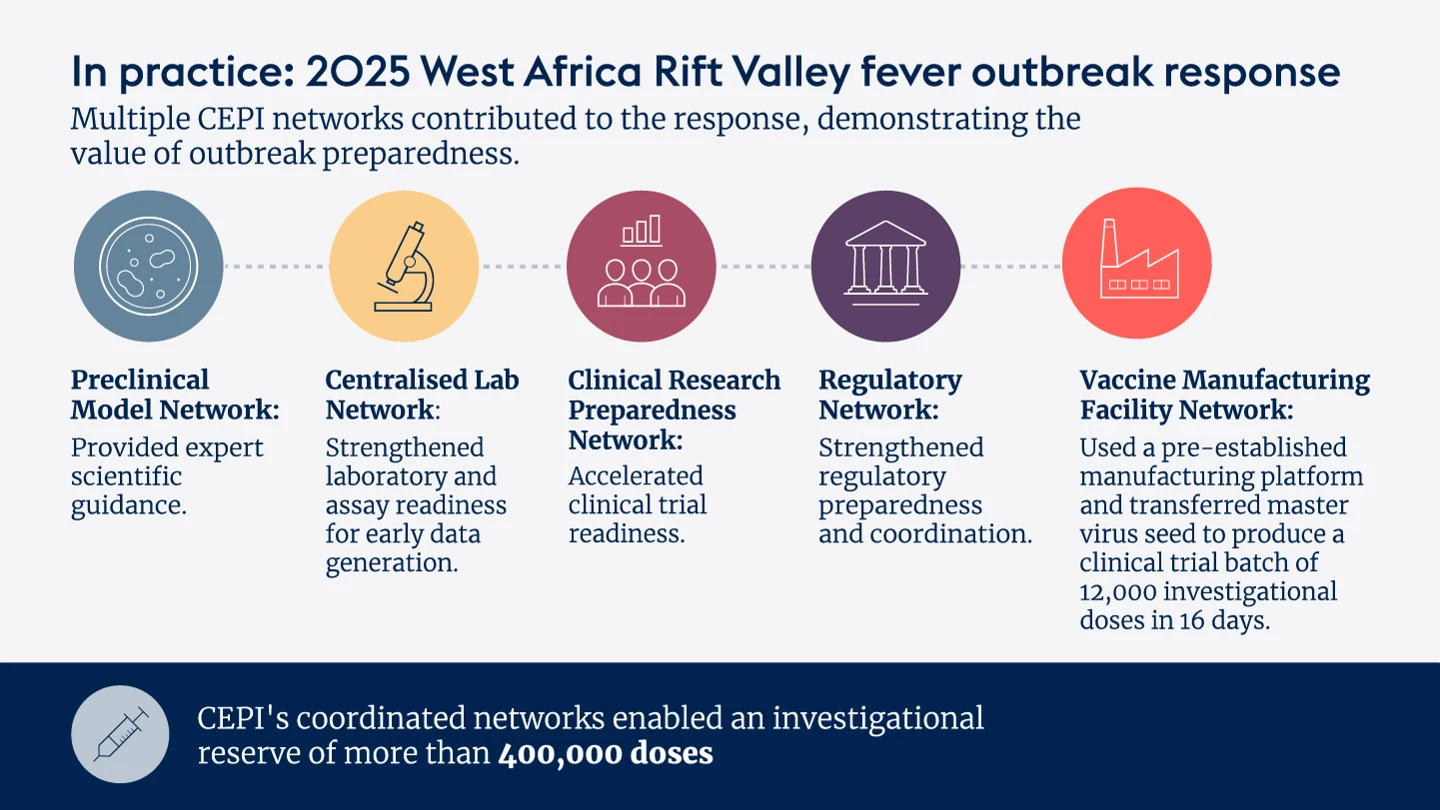
Take the Global South Leaders in Epidemic Analytic and Response Network (GS-LEARN). This initiative strengthens response systems in regions where new threats are more likely to emerge, meaning signals are picked up earlier by local epidemiologists and acted on faster. The Clinical Research Preparedness Network helps CEPI-supported clinical trial sites to generate vital vaccine data during emergencies. The Vaccine Manufacturing Facility Network (VMFN) ensures that manufacturing capacity in the Global South can be mobilised at speed, while the Centralised Lab Network (CLN) and the Preclinical Model Network (PMN) generate standardised vaccine response data that cuts through the noise for decision-making. The Regulatory and Quality Network works from preparedness to authorization through collaboration, innovation and reliance, and assures cross-cutting trusted quality systems that enable rapid, safe and scalable outbreak response.
Together, these networks turn what could be blind spots into early-warning systems, and early warning into early action, which is the difference between containing an outbreak and watching it spiral
How does this approach move us from reacting to outbreaks to proactively preparing for them?
Outbreak-ready networks create a world where response isn’t improvised, but rather rehearsed.
CEPI engages partners across surveillance, labs, clinical trials, manufacturing and regulation to practise working together through real-world responses and simulation exercises during quieter periods. These rehearsals build trust, coordination and a shared rhythm. So, when a threat emerges, partners don’t waste time figuring out who does what. They already know because they’ve done it before.
During COVID-19, the global response was often described as “building the plane while flying it” - CEPI’s outbreak-ready networks are designed to ensure that next time, the plane is already built, tested and waiting on the runway.
How do the networks help deliver the 100 Days Mission?
The engine here is cross-cutting preparedness work and repetition... deliberate, structured, end-to-end practice during interepidemic periods.
Under CEPI 3.0, the networks will rehearse critical parts of the vaccine development and manufacturing process so gaps can be identified and fixed before an emergency to ultimately deliver the 100 Days Mission. Epidemiological monitoring systems are strengthened to support faster decision-making. Laboratory networks are ready to generate immunology and virology data. Clinical trial networks can rapidly initiate well-designed studies. Manufacturing partners are prepared to produce vaccines using pre-established vaccine platforms, quality systems and compliance is built into all preparedness work and regulators are engaged early for pre-approvals and to align on accelerated emergency pathways. Together, these capabilities create the conditions needed to meet the 100-day target.
How do we ensure this approach is regionally anchored and not just for high‑income countries?
Equity is the foundation of CEPI’s outbreak-ready networks. Many networks, including GS-LEARN and Clinical Research Preparedness Network, are based entirely in low- and middle-income (LMIC) regions. Manufacturing partners are predominantly located in LMICs and include explicit equity clauses to ensure that vaccines produced with CEPI support are accessible to those who need them most. Other networks, such as the Regulatory and Quality, Preclinical Model and Centralised Lab Networks, intentionally span both high- and low-income countries to enable knowledge sharing, technology transfer and long-term capacity strengthening.
How does this work prepare us for a Disease X scenario?
Every network contributes directly to CEPI’s Disease X readiness. If a novel, potentially pandemic-causing virus emerged tomorrow, rather than scrambling around, these networks would activate immediately: detecting and characterising the threat, generating the data needed to guide vaccine design, understanding early efficacy signals, initiating trials at speed and beginning regional manufacturing using CEPI-supported platforms.
Because these networks are embedded in regions where outbreaks are more likely to occur, they bring local insight and established systems that help the world move faster when the next unknown threat, the next Disease X, appears.
How does this priority area rely on and strengthen the others?
Outbreak‑ready networks sit at the centre of CEPI 3.0. When a new threat appears, the viral family knowledge base means scientists already know where to start; the platform technologies mean manufacturing can pivot quickly; and the networks ensure those capabilities are activated simultaneously -- linking labs, trial sites, manufacturers and regulators across continents.
These networks also strengthen CEPI’s cross-cutting themes: supporting AI adoption in LMICs, embedding biosecurity through standards like ISO 35001, and enabling technology transfer and quality and regulatory alignment across regions. The result is a system that is more efficient, more equitable and more regionally representative, which is exactly what the 100 Days Mission demands.
CEPI 3.0 cross-cutting themes explained: Biosecurity
CEPI 3.0 explained: Platform technologies