The 100 Days Mission
CEPI’s 100 Days Mission aims to develop safe, effective and accessible vaccines within 100 days of identifying a new pandemic threat. That’s just over three months from the recognition of the threat to a vaccine being ready for initial authorisation and manufacturing at scale.

The 100 Days Mission
Ground-breaking new medical defences against COVID-19 were developed and built in record time when the novel coronavirus SARS-CoV-2 emerged and spread rapidly around the world. Within just 326 days, the first safe and effective vaccines were being rolled out to begin to reduce cases of severe disease and bring down COVID-19 death rates.
The pace of this development and delivery was unprecedented. Yet it was still not fast enough to prevent COVID-19 from exploding into a deadly global pandemic. To prevent future outbreaks from realising their pandemic potential, the world needs to up the pace in the race against new and re-emerging viruses. If it takes just 100 days to make a safe and effective vaccine against any viral pandemic threat, we could potentially contain outbreaks before they spiral out of control.
This goal is known as the 100 Days Mission. It is embraced by leaders of the G7 and G20, and is widely recognised as an ambitious global collaborative effort.
Potential impact of the 100 Days Mission on COVID-19
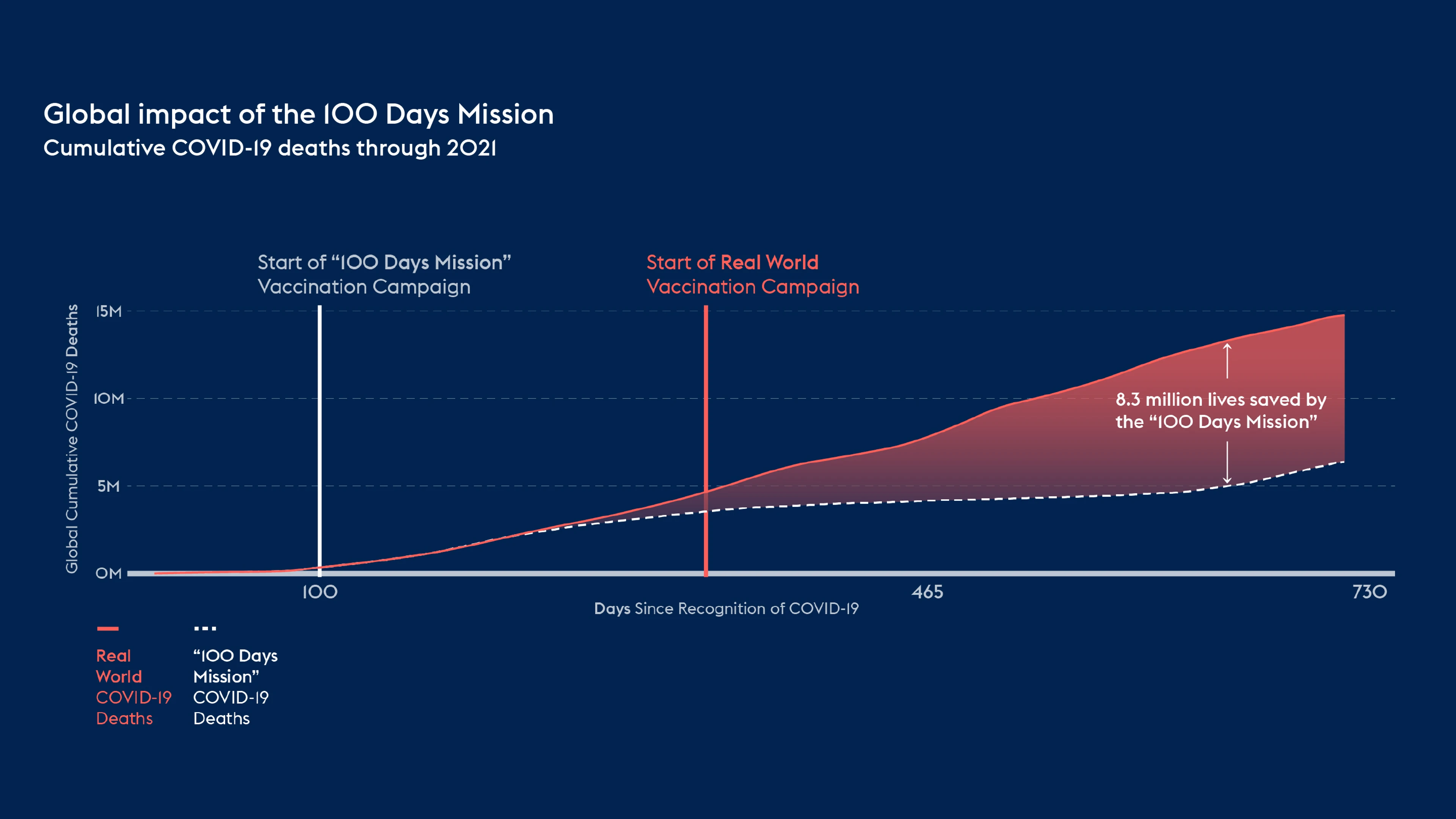
More than eight million people who died during the COVID-19 pandemic might be alive today if the world had achieved the 100 Days Mission to develop safe and effective new vaccines against the novel SARS-SoV-2 virus.
Research, commissioned by CEPI and carried out by infectious disease modellers at Imperial College London, showed that if safe and effective COVID-19 vaccines were available by April 2020 (ie, within 100 days of the release of the genome sequence on 10 January), 8.3 million excess deaths could have been averted by the end of 2021 yielding substantial health, health economic, and economic benefits. In addition, almost $1.4 trillion in productivity losses due to illness could have been averted along with over $63 billion of hospitalisation costs.
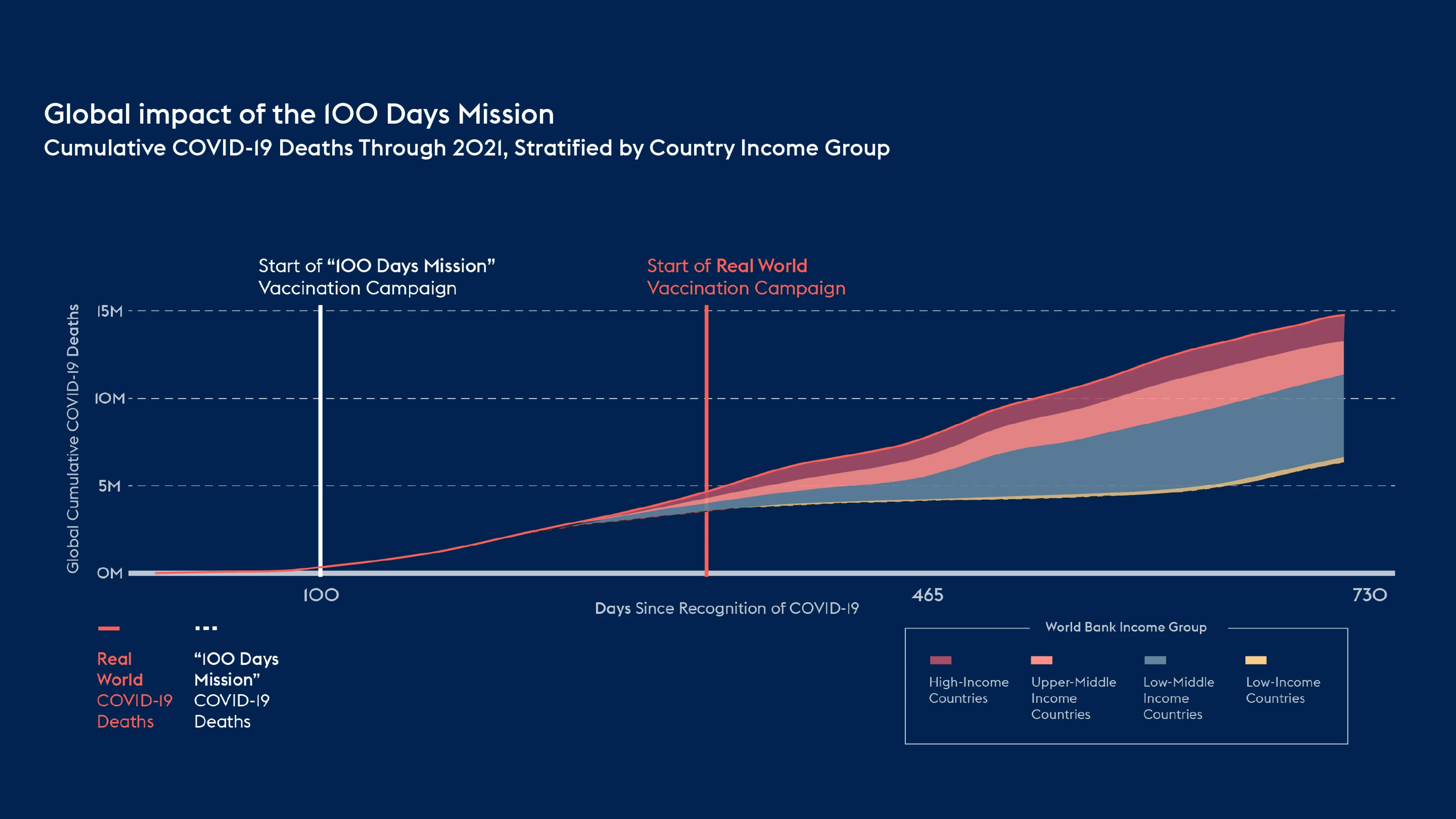
In lower middle-income countries, a successful 100 Days Mission could have saved 4.8 million lives, prevented 800 million COVID-19 infections and averted 15.7 million COVID-19 hospitalisations, by the end of 2021.
The COVID-19 pandemic showed with painful clarity that the enemy of equity is scarcity: when there isn’t enough to go round, those with the means to pay are served first. The height of the COVID-19 pandemic was characterised by tragic inequity of access to vaccines, precisely because those vaccines were in short supply. But in a world where the 100 Days Mission has been accomplished that period of scarcity could be dramatically reduced, saving many lives and averting huge economic damage. That is why the CEPI’s pandemic preparedness plan is underpinned by the 100 Days Mission.
What Will It Take?
Accomplishing the 100 Days Mission could transform the world’s approach to epidemic and pandemic preparedness from one of reactive response to rapid, anticipatory readiness. to speed up vaccine development and delivery and to harness the crucial scientific and technological innovations that can enable those at highest risk in an emerging epidemic to be protected as swiftly as possible.
CEPI is putting in place the building blocks and capabilities needed to achieve the 100 Days Mission. Its next five-year strategy, CEPI 3.0, aims to drive the 100 Days Mission towards an operational reality. Through focused investments in interconnected priority areas, CEPI will advance vaccines for both known and emerging viral threats, strengthen platform technologies so they are ready and available to accelerate vaccine development and support global networks that are ready to respond to future threats swiftly and equitably, whenever and wherever they emerge.
Coupled with strengthened worldwide disease surveillance capabilities and early-warning systems, and accelerated identification of immune response markers, these efforts will save vital days and weeks when the world needs to respond at speed to a potential pandemic threat.
Increased Speed = Greater Equity
The 100 Days Mission has equity at its core, aiming to swiftly defend those at the highest risk from emerging viral threats. The faster vaccines can be deployed, the smaller the outbreak is likely to be.
Learn more
A global endeavour
No single organisation, country or region can be ready to achieve the 100 Days Mission alone.
Success will require advances in the organisation, governance, and financing of global preparedness systems, and multiple, interconnected scientifically guided collaborative efforts.
Join us in building a future where pandemics no longer threaten our way of life.