Dr Navneet Bichha: My Fellowship at CEPI
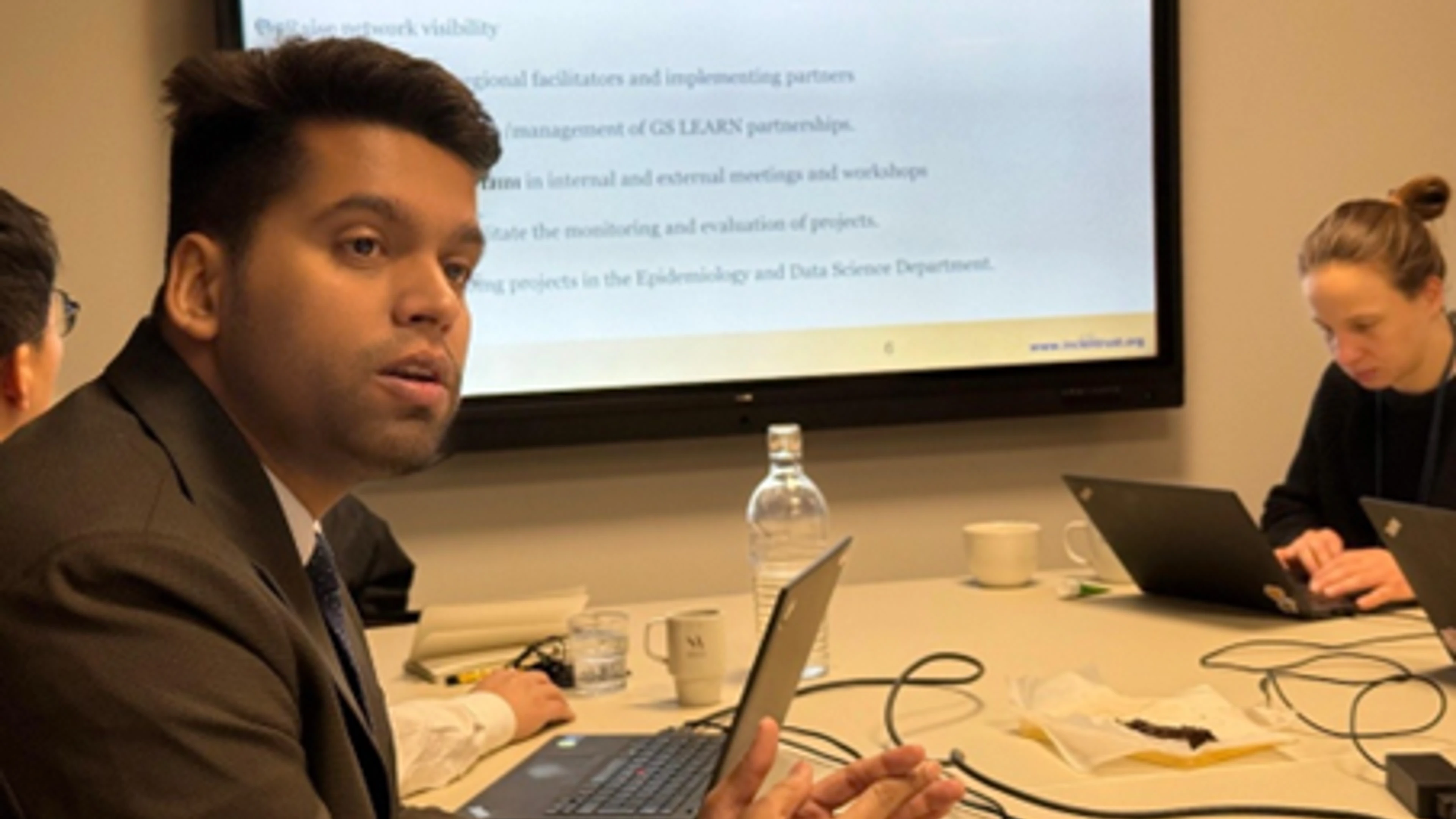
In mid-2025 CEPI welcomed its second cohort of Global South Fellows. The Fellowship Programme aims to build capacity for future global health leaders, enhance readiness for the 100 Days Mission in the Global South, and facilitate knowledge exchange through improved global collaboration, in support of CEPI’s vision for a pandemic-free future.
Now, halfway through the year-long fellowship, we caught up with Dr Navneet Bichha—one of the Fellows embedded in CEPI’s Epidemiology and Data Science Department—to discuss his experience.
Can you tell me a bit about yourself?
My name is Dr. Navneet Bichha—a public health physician from Nepal with a wide range of experience in infectious disease epidemiology, vaccinology, and implementation research. I’m currently working as a Senior Program Officer at The INCLEN (International Clinical Epidemiology Network) Trust International, New Delhi, a not‑for‑profit focused on advancing clinico‑epidemiological research. Here, I lead the vaccine safety surveillance and disease modelling research for priority pathogens in the Global South.
How does your work help to contribute to pandemic preparedness and response?
Throughout the COVID-19 pandemic and beyond, my work was focused on the intersection of outbreak response, clinical research, and national policy. I have served as a medical investigator in vaccine trials for cholera and COVID-19 in partnership with the International Vaccine Institute (IVI) to establish critical safety and efficacy data. This clinical foundation informed my later work with the Ministry of Health and the Sabin Vaccine Institute, where I helped shape Nepal’s national immunisation implementation strategy for new vaccine introduction. Currently, I am dedicated to strengthening global pharmacovigilance research capacity with The INCLEN Trust International, collaborating with partners like Global Vaccine Data Network and CEPI to evaluate background rates of vaccine-related adverse events, informing risk management strategies for future vaccine rollouts.
Tell me about the project you’re working on at CEPI
As a Global South Leaders in Epidemic Analytics and Response Network (GS-LEARN) Fellow, I strengthen pandemic preparedness by expanding analytical leadership across the Global South. I help drive the initiative’s impact by managing key dissemination efforts through the WHO Collaboratory Hub and The Global Health Network (TGHN), linking regional insights to a global network of practitioners. This involves close coordination with regional facilitators to harmonise activities and foster high-level institutional partnerships.
Beyond network coordination, I support the development of monitoring and evaluation frameworks, including Theory of Change (ToC) log frames—a strategic mapping tool that defines the causal pathway from specific activities to long-term goals—aligned with CEPI’s 3.0 strategy. These tools ensure that tabletop exercises and capacity-building efforts translate into measurable improvements in outbreak response.
I also collaborate with CEPI’s Data Science team and INCLEN (supervised by Dr. Arminder Deol and mentored by Dr. Christinah Mukandavire and Prof. Narendra Arora) to develop infectious disease models for Chikungunya in India, ensuring advanced analytical tools are grounded in regional expertise.
What skills have you been able to share with CEPI during your fellowship?
I have shared extensive technical expertise in infectious disease epidemiology and vaccinology to support the 100 Days Mission. By establishing baseline rates for mortality and hospitalisation, I have provided the analytical skills necessary to enable accurate causal assessments across various vaccine platforms in the Global South. This technical contribution extends to my work with CEPI’s Data Science team and INCLEN, where I am producing policy-relevant estimates of the Chikungunya disease burden in India to support strategic investment and preparedness.
What skills have you learned while being a Global South Fellow at CEPI?
The fellowship has provided a unique platform to evolve my skill set through cross-departmental collaboration and advanced technical training. By working closely with the Strategic Planning and Data Science teams, I have honed my strategic thinking skills, specifically in developing Theory of Change log frames. This has been complemented by my work with the Preparedness and Response team, where I learned to design and facilitate scenario-based tabletop exercises—a critical skill for testing real-world pandemic readiness.
On a technical level, I have significantly expanded my expertise in infectious disease modelling. Through advanced training at Imperial College London and ICMR–NIE, Chennai, I have gained proficiency in R Studio, which I am now applying to model local Chikungunya data.
What do you hope to have achieved by the end of your fellowship?
I aim to have further established GS-LEARN as a sustainable platform for analytical leadership in the Global South, bridging North-South and South-South gaps in pandemic preparedness. I also hope to increase the participation of regional experts in global response forums, ensuring that GS-LEARN provides a lasting framework for coordinated epidemic analysis.
Further, I intend to have delivered actionable modelling insights for Chikungunya vaccines in India—including transmission dynamic and cost-effectiveness analyses—to directly support CEPI’s 100 Days Mission.
And, crucially, I hope to have formalised a permanent partnership between INCLEN and CEPI, ensuring that these regional data standards and collaborative networks continue to thrive long after my fellowship concludes.
CEPI and World Bank Group partner to strengthen sustainable vaccine manufacturing in ASEAN
Tracking Lassa fever: Where are we up to?