European Union and Singapore Back CEPI’s Plan to Boost Global Defences Against Epidemic and Pandemic Threats
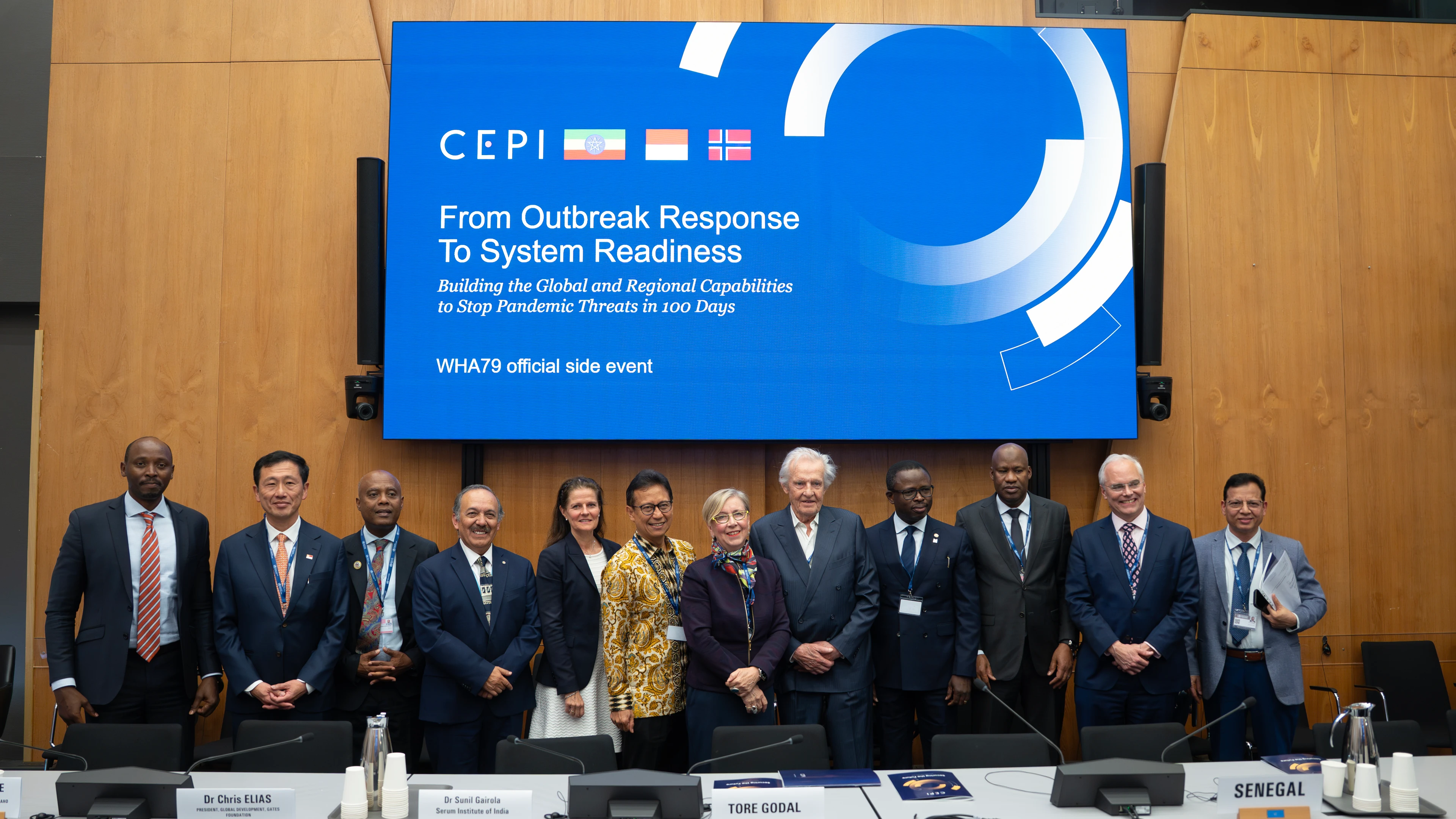
- Major new investments bolster global coalition's five-year plan to develop vaccines against the most dangerous pathogens and transform the world’s ability to tackle epidemic and pandemic threats.
- Current outbreaks, including the deeply concerning emergence of Ebola caused by Bundibugyo virus, underscore the persistent and evolving threat posed by infectious diseases and the urgent need to invest to strengthen preparedness.
19 May 2026, GENEVA:The Coalition for Epidemic Preparedness Innovations (CEPI) today welcomed landmark financial commitments from two of the world's leading health security partners at a World Health Assembly event. The European Union (EU) has committed €73.7 million through its Horizon Europe framework programme, and Singapore has pledged US$12 million to support CEPI’s work to transform the world's ability to prevent and respond to epidemic and pandemic threats. Against the backdrop of a deeply concerning outbreak of Ebola caused by Bundibugyo virus, these commitments signal important international support for CEPI 3.0 – the coalition’s five-year strategy for 2027-2031 - and CEPI’s urgent work to tackle the growing threat posed by infectious disease outbreaks.
Dr Richard Hatchett, CEO of CEPI, said: “The major new commitments made by the European Union and Singapore are a vital signal of global resolve and leadership that bring us closer to realising CEPI 3.0’s transformative potential. Concurrent outbreaks of hantavirus and Ebola caused by Bundibugyo virus serve as stark reminders that the gap between the threats we face and our readiness to meet them remains dangerously wide. These investments will help strengthen the world’s disease defences so we are ready to respond rapidly and equitably to emerging viral threats.”
The EU’s financial commitment of €73.7 million will support CEPI’s work in 2026 and 2027, maintaining the current annual level of funding. The EU is a long-standing partner and investor in CEPI’s mission. Supported by Horizon 2020 and Horizon Europe co-funding, CEPI has advanced vaccines for Chikungunya, Filoviruses, Rift Valley fever and other priority pathogens, strengthening Europe’s and the world’s ability to tackle emerging viral threats in close alignment with the EU’s medical countermeasures and life sciences strategies.
Dr Florika Fink-Hooijer, Director General of DG HERA, said: “Ensuring access to medical countermeasures for the most vulnerable is a key EU priority for health emergency preparedness and response. The Commission’s Global Health Resilience Initiative includes support to CEPI for the development of vaccines, feeding into the 100 Days Mission to produce a safe and effective vaccine within 100 days of a pandemic declaration. This support also contributes to better preparedness for infectious diseases that may spread beyond their current areas, including into parts of Europe.” Marc Lemaître, Director General of DG Research and Innovation,added: “Through Horizon Europe, including in partnership with CEPI, the EU is investing in the full innovation pathway for new vaccines, from research and clinical studies to real-world deployment, including in low- and middle-income countries. Investing together in research and innovation, strengthening the scientific evidence base, and ensuring that new health solutions can be developed, is essential for global health security.”
Singapore’s financial commitment of US$12 million from 2027 to 2030 will support the delivery of the CEPI 3.0 strategy. With its strong innovation and manufacturing capabilities and regional reach, Singapore is a valued partner for CEPI across activities including preparing for regional threats, developing globally distributed RNA manufacturing design capabilities, and strengthening regulatory systems. Singapore’s leadership and continued investment in CEPI reflect a shared commitment to global health security and building capabilities that can protect populations in Asia and globally against epidemic and pandemic threats.
In his address at today’s event, Mr Ong Ye Kung, Minister for Health and Coordinating Minister for Social Policies, Singapore, said: "Singapore has invested steadily in vaccine research and development, and also manufacturing capability and capacity. But we recognise we are a very small country. Our national efforts must fit into a larger global effort. Our partnership with CEPI has deepened our own capabilities, including in scientific advisory engagement, regulatory preparedness, R&D and manufacturing collaboration, while allowing us to continue to contribute meaningfully to this broader global effort. As we look ahead to CEPI 3.0, we see a natural continuation of this partnership."
CEPI 3.0: a plan to secure the future against epidemic and pandemic threats
Current outbreaks of Hantavirus and Ebola caused by Bundibugyo virus underscore the persistent and evolving threat posed by infectious diseases and the urgent need to strengthen preparedness. Research indicates that the risk of another pandemic on the scale of COVID-19 within our lifetimes is significant, and that global economic losses from future pandemics are estimated to average more than US$700 billion per year. Left unchecked, outbreaks of viruses such as Lassa, Nipah, Rift Valley fever and the next unknown pathogen - known as Disease X - represent an escalating threat to human life, global health systems, and economic stability.
At the same time, the world is better equipped than ever to respond - if it chooses to invest. Advances in vaccinology, genomics, artificial intelligence and biomanufacturing have unlocked the possibility of developing safe, effective and accessible vaccines against new pandemic threats in as little as 100 days of their identification. This goal, known as the 100 Days Mission and endorsed by G7 and G20 leaders, sits at the heart of CEPI 3.0.
To deliver this step-change in preparedness, the CEPI 3.0 strategy centres on three interconnected priorities: developing vaccines to tackle the most dangerous pathogens and viral families; advancing rapid-response vaccine platform technologies capable of being swiftly adapted to unknown viruses; and strengthening global networks for research, manufacturing and regulatory readiness that can be activated swiftly whenever and wherever future threats emerge.
– ENDS –
Notes to Editors
CEPI is seeking additional investment of US$2.5 billion to unlock its plan to protect the world against epidemic and pandemic threats. Read the CEPI 3.0 Investment Case here.
About CEPI
CEPI is an innovative partnership between public, private, philanthropic and civil organisations. Its mission is to accelerate the development of vaccines and other biologic countermeasures against epidemic and pandemic threats so they can be accessible to all people in need. Central to CEPI’s pandemic-beating plan is the ‘100 Days Mission’ to develop safe, effective and accessible vaccines against new threats in just 100 days. CEPI is seeking $2.5 billion to execute CEPI 3.0, its 2027-2031 strategy which will systematically reduce the likelihood, impact and cost of epidemics and pandemics by driving the 100 Days Mission towards an operational reality. Learn more at CEPI.net.
About Horizon Europe
Horizon Europe — #HorizonEU — is the European Union's flagship Research and Innovation programme, part of the EU-long-term Multiannual Financial Framework (MFF) with a budget of EUR 95,5bn to spend over a seven-year period (2021-2027). Under Horizon Europe, health research is supported with the aim to find new ways to keep people healthy, prevent diseases, develop better diagnostics and more effective therapies, use personalised medicine approaches to improve healthcare and wellbeing, and take up innovative health technologies, such as digital ones.
CEPI
- Email:
- [email protected]
- Phone:
- +44 7387 055214
UK rabies vaccine trial could also unlock protection against Disease X
_Andreas%20Kravik%20(Norway)_Chris%20Elmore%20(UK)_Abnet%20Zeleke%20(Ethiopia)_Mamadou%20Ndiaye%20(Senegal)_Sept%2021_2026.webp)
Ethiopia, Norway and UK commit US$240 million to CEPI’s global plan to tackle epidemic and pandemic threats